
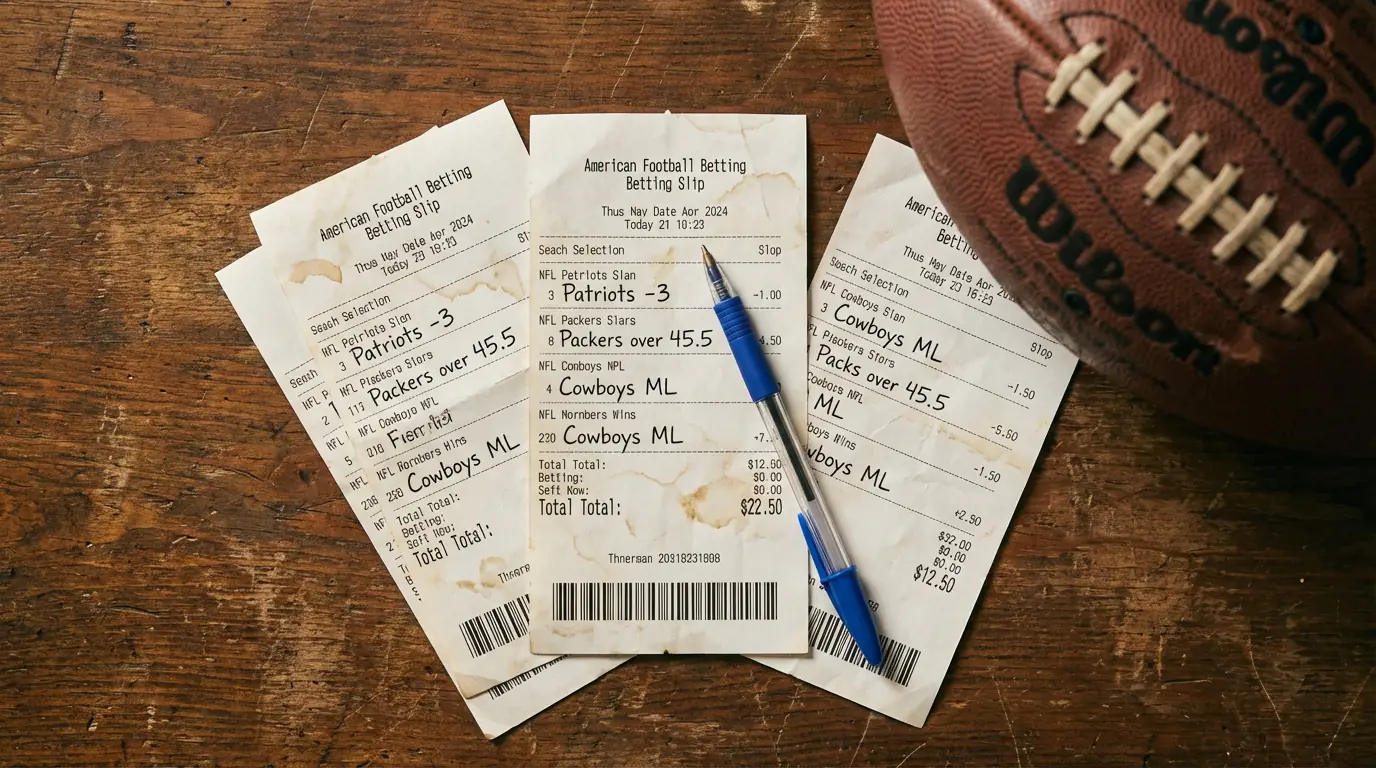
Parlays are the lottery tickets of football betting. They combine multiple individual bets into a single wager where every selection must win for the bet to pay out. Hit all legs and the payout is massive. Miss one and you lose everything. That all-or-nothing structure is what makes parlays the most popular bet type among recreational bettors — and the most profitable product for sportsbooks.
The appeal is obvious. A $10 parlay on three NFL games can return $60 or more. String together five or six winners and the payout balloons into the hundreds. Sportsbooks know this, which is why every major platform promotes parlays aggressively. But behind the flashy payouts is a mathematical reality that every bettor should understand before combining their first two legs.
Multi-Leg Parlay Compounding Odds Math
A parlay links two or more individual bets — called legs — into a single wager. All legs must win for the parlay to pay. If any single leg loses, the entire parlay is graded as a loss. In the event of a push on one leg (the result lands exactly on the number), that leg is typically removed from the parlay and the payout recalculates based on the remaining legs.
The mechanics are simple. You select your bets — say, Chiefs -3, Bills over 47.5, and Eagles moneyline — and combine them into one ticket. Instead of placing three separate $10 bets with three separate payouts, you place one $10 bet that only pays if all three outcomes hit. The trade-off for accepting that increased risk is a significantly larger payout than you would earn from three individual wagers.
Sportsbooks calculate parlay odds by multiplying the decimal odds of each leg together. If each of your three legs is priced at -110 (decimal: 1.909), the combined decimal odds are 1.909 x 1.909 x 1.909 = 6.96. A $10 bet returns $69.60, including your stake. The same three bets placed individually at $10 each would return $19.09 per win, for a maximum total of $57.27 if all three hit — but you would also collect partial returns if only one or two win, which you cannot do with a parlay.
The number of legs in a parlay is theoretically unlimited, though most sportsbooks cap it at 10-15 selections. Two-leg parlays (also called doubles) offer modest payout boosts. Three-leg parlays (trebles) are the most common structure. Beyond four or five legs, the payouts grow exponentially but the probability of winning collapses at a rate that most bettors dramatically underestimate.
The Math That Works Against You
The fundamental problem with parlays is that the combined probability of hitting every leg drops much faster than human intuition expects. If each leg of a three-team parlay has a 50% chance of winning, the probability of all three hitting is 0.50 x 0.50 x 0.50 = 12.5%. For a five-team parlay: 0.50^5 = 3.1%. For ten teams: 0.50^10 = 0.098%, or roughly one in a thousand.
Those numbers assume fair coin-flip odds. In reality, standard -110 bets carry an implied probability of 52.4% for each side, meaning the sportsbook has already tilted the math in its favor on every individual leg. When you multiply that edge across multiple legs, the compounding effect accelerates. The house edge on a single -110 bet is about 4.5%. On a three-leg parlay of -110 bets, the effective house edge climbs to roughly 13%. On a five-leg parlay, it approaches 20%. The sportsbook’s margin does not just add across legs — it multiplies.
This compounding is the core reason sportsbooks love parlays. Every additional leg you add increases the book’s expected profit from your bet. The payout you see is real and accurate, but it is calibrated to ensure the sportsbook retains a growing percentage of the total handle as parlay sizes increase. You are not getting free money when you add that fourth or fifth leg. You are paying an exponentially increasing tax for the privilege of a bigger number on the payout screen.
There is also a psychological trap in how parlays are marketed. Sportsbooks show potential payouts prominently — “$10 to win $520” on a six-team parlay — without displaying the probability of winning. If that same parlay has a 1.5% chance of hitting, the expected value of the bet is roughly $7.80 on a $10 wager. You expect to lose $2.20 every time you place it, on average. The payout looks impressive, but the math is quietly brutal.
Strategic Approaches to Parlays
Dismissing parlays entirely would be intellectually lazy. While the math favors the sportsbook on standard parlays, certain strategic approaches can reduce the disadvantage or exploit specific market conditions.
Correlated parlays are the most mathematically sound parlay strategy. Correlation means the outcomes of two legs are linked — if one hits, the other becomes more likely. The classic example: betting a team’s moneyline and the game over. If a team wins, it usually means they scored enough points to contribute to a high total. Sportsbooks are aware of this correlation and will block obviously correlated parlays in traditional markets, but the same-game parlay feature on most platforms allows some correlated combinations that the book’s algorithm does not fully price.
Small parlays with strong edges represent another viable approach. If you have genuine analytical edges on two or three individual games, combining them into a small parlay amplifies the return. The key word is “genuine” — if your edge on each leg is, say, 3% above the implied probability, a two-leg parlay preserves most of that edge while boosting the payout. The compounding vig is modest on two-leg parlays (roughly 9% house edge versus 4.5% on a single bet), and the payout increase partially compensates.
The worst parlay strategy is the one most people use: randomly combining five or six bets because “they all look good.” Every leg you add without a quantifiable edge is pure entertainment expense. There is nothing wrong with entertainment, but calling it a strategy is dishonest. If you want to throw $5 on a six-team parlay for fun during Sunday’s games, go ahead. But do not confuse that with an investment approach. The distinction matters because it affects how much you are willing to risk and how you respond emotionally when the bet inevitably loses.
When Parlays Actually Make Sense
There are legitimate situations where a parlay is the correct bet structure, not just the exciting one.
The first is bankroll leverage. If you have a small betting bankroll and strong confidence in two or three games, a parlay lets you generate a meaningful payout from a modest stake. A $20 two-leg parlay at standard odds returns about $52, while two individual $20 bets return a maximum of $38.18 per win. If your bankroll is $200 and you want exposure to multiple games without spreading thin, a small parlay concentrates your risk and reward efficiently.
The second is when you can identify mispriced correlations. Same-game parlays occasionally offer combinations where the sportsbook’s pricing algorithm does not fully account for how one outcome affects another. A running back’s rushing yards over combined with his team’s moneyline in a game where the team is likely to build a lead and run the clock is a mild correlation that SGP algorithms sometimes underprice. These edges are small and inconsistent, but they exist.
The third, perhaps counterintuitively, is when you are building long-shot positions deliberately. Futures parlays — combining two or three long-shot futures at high plus odds — have extremely low win probabilities but asymmetric payouts. If you allocate a fixed small percentage of your bankroll to these bets and treat them as high-risk, high-reward positions rather than expected income, the occasional hit can produce outsized returns. This is portfolio thinking applied to betting, and it works only if the long-shot allocation is genuinely small (1-2% of bankroll per bet).
The Parlay Paradox
The irony of parlays is that they are simultaneously the worst bet on the board by expected value and the bet that generates the most stories. Nobody writes about their -110 spread bet that won $100. Everybody writes about their $25 five-leg parlay that returned $800. Those stories are real, and they happen. But for every one that lands, hundreds of identical parlays died quietly, one missed leg at a time.
This is the parlay paradox: the product is designed to be unprofitable in aggregate, yet the emotional experience of hitting one is so powerful that it overrides the mathematical reality. Sportsbooks understand behavioral economics better than most bettors understand football. They know that the memory of a parlay win lingers far longer than the memory of a parlay loss. They know that showing you a potential $500 payout on a $10 stake triggers a dopamine response that a single -110 bet never will. And they price accordingly.
The sharpest approach to parlays is to treat them as a controlled indulgence within a broader strategy — not as the strategy itself. Allocate a fixed, small portion of your weekly betting budget to parlays. Keep the legs at two or three. Require an analytical reason for each selection, not just a feeling. And when the parlay loses, as it most often will, remember that the $10 you spent was budgeted for entertainment, not earmarked for profit. The bettors who get into trouble with parlays are the ones who reverse this equation — who budget for profit and end up paying for entertainment.
