
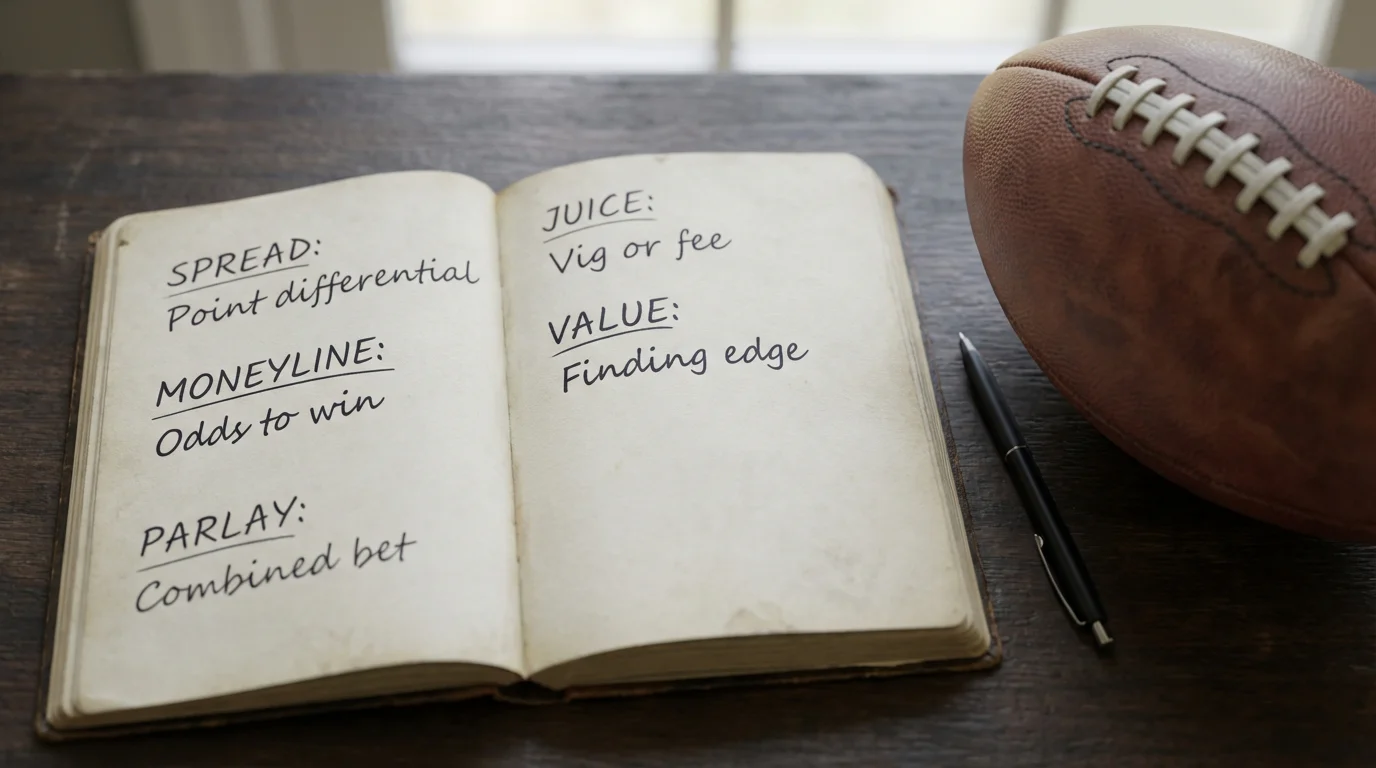
Football betting has its own language, and fluency in that language is not optional. Walk into a sportsbook conversation without knowing the difference between juice and chalk, or between a cover and a push, and you will misunderstand advice, misread lines, and misplace bets. This glossary defines the essential terms in plain language, organized by category so you can find what you need and build vocabulary in context rather than alphabetical isolation.
Sportsbook Pricing & Institutional Edge
Action refers to any wager placed on a game, or more broadly to the total amount of money bet on a particular event. When someone says “there is heavy action on the Chiefs,” they mean a disproportionate amount of money has been wagered on Kansas City.
Juice (also called vig or vigorish) is the sportsbook’s commission on every bet. At standard -110 odds, the juice is the extra $10 you risk above the $100 you stand to win. It is how the book makes money regardless of which side wins. Reduced juice refers to sportsbooks that charge less than the standard -110, typically -105 or -107, offering bettors a lower effective tax per wager.
Chalk describes the favorite in a game. When someone says “the chalk won again,” they mean the favored team won. Laying chalk means betting on the favorite, accepting a worse payout ratio in exchange for a higher probability of winning.
Even money (or pick ’em) describes a line where neither team is favored. Both sides are priced at -110 or +100, and the spread is effectively zero. These games are considered too close to call by the sportsbook’s models.
Implied probability is the percentage chance of an outcome that the odds represent. At -200, the implied probability is 66.7%. At +300, it is 25%. Understanding implied probability lets you evaluate whether the price you are getting is fair relative to how likely you believe the outcome to be.
Overround (also called the margin or hold) is the total of implied probabilities across all outcomes in a market, minus 100%. A market with -110 on both sides has an overround of 4.8%, which represents the sportsbook’s built-in edge.
Steam refers to a sudden, significant line movement caused by heavy, coordinated betting action — typically from sharp bettors or syndicates. When a line steams from -3 to -4.5 in an hour, it usually means professional money has identified value on that side.
Handle is the total dollar amount wagered on an event. The Super Bowl handle at legal U.S. sportsbooks is projected at approximately $1.76 billion for 2026. Hold is the percentage of the handle that the sportsbook retains as profit after paying out winners — typically 5-8% on most football markets.
Bet Types and Structure
Moneyline is a straight-up bet on which team will win the game, with no point spread involved. The odds vary based on each team’s perceived probability of winning.
Point spread (or simply spread) is the handicap assigned to equalize a matchup. The favorite is listed with a minus number (-3.5) and must win by more than that margin. The underdog is listed with a plus number (+3.5) and can lose by fewer points than the margin — or win outright — to cash the bet.
Total (or over/under) is a bet on the combined score of both teams. The sportsbook sets a number, and you bet whether the actual combined score will be higher (over) or lower (under).
Parlay combines multiple bets into a single wager. All selections must win for the parlay to pay out. The potential return increases with each added leg, but so does the probability of losing.
Teaser is a type of parlay where you adjust the point spread in your favor on each selection, typically by 6 or 7 points. The trade-off is a lower payout than a standard parlay of the same number of legs.
Same-game parlay (SGP) combines multiple bets from the same game into one wager. Unlike traditional parlays where legs are from different games, SGPs allow correlated selections within a single matchup.
Round robin takes a set of selections and creates every possible parlay combination of a specified size, providing protection against one or two losing picks.
Prop bet (short for proposition) is a wager on a specific occurrence within a game that is not directly tied to the final outcome. Player props include stats like passing yards or touchdowns for a specific player. Game props include events like whether there will be overtime or which team scores first.
Futures are bets on outcomes decided at the end of a season or tournament — Super Bowl winner, MVP, division champions, win totals.
Live betting (also called in-play or in-game) refers to wagers placed after a game has started, with odds that update continuously based on the current score and game state.
Results, Outcomes, and Line Movement
Cover means a bet wins against the point spread. If the favorite is -7 and wins by 10, they covered. If the underdog is +7 and loses by 3, they covered. Covering is distinct from winning the game — a team can win outright and fail to cover if the margin is smaller than the spread.
Push occurs when the final margin lands exactly on the spread number. If the spread is -3 and the favorite wins by exactly 3, the bet is a push and the stake is refunded. Pushes are neither wins nor losses, and sportsbooks use half-point spreads (-3.5 instead of -3) specifically to eliminate them.
Bad beat is an outcome where a bet that appeared certain to win is lost due to a late, improbable event — a garbage-time touchdown, a meaningless last-second field goal, or a turnover in the final minute that flips the spread result. Bad beats are an emotional reality of football betting and a reason why bankroll management matters.
Backdoor cover occurs when the losing team scores late to cover the spread without ever being competitive in the game. If the favorite leads 31-10 and the underdog scores two late touchdowns to make it 31-24, the underdog covered a +7 spread through the back door.
Sharp money refers to wagers placed by professional or highly informed bettors. Sharp money moves lines because sportsbooks respect the analytical quality behind these bets. Square money (or public money) comes from recreational bettors and typically flows toward popular teams, favorites, and overs.
Line movement is any change in the odds or spread between the time the line opens and the time the game kicks off. Lines move in response to betting action, injury news, weather updates, and other information. Opening line is the first number posted by the sportsbook. Closing line is the final number available at kickoff, and it is widely considered the most accurate reflection of true probabilities.
Reverse line movement (RLM) occurs when the line moves in the opposite direction of where the public money is going. If 70% of public bets are on the favorite and the line moves toward the underdog, it indicates that sharp money on the underdog side is outweighing the volume of public action. RLM is one of the most tracked indicators for identifying where professional bettors are positioned.
Off the board means a game has been temporarily or permanently removed from betting. This typically happens when a key player’s status is uncertain or when breaking news changes the expected conditions of the game.
Strategy and Analysis Terms
Value (or +EV) describes a bet where the probability of winning is higher than the implied probability of the odds. A bet at +150 has value if the true probability of winning exceeds 40%. Finding value is the fundamental objective of professional betting.
Expected value (EV) is the mathematical average outcome of a bet over infinite repetitions. A positive EV bet returns more than it costs over the long run. A negative EV bet loses money over the long run. Every bet placed at standard vig without an analytical edge carries negative EV.
Bankroll is the total amount of money dedicated specifically to betting. It is separate from personal finances and serves as the capital base from which all bets are sized. A unit is the standard bet size, typically 1-3% of the total bankroll.
Closing line value (CLV) measures whether you got a better price than the closing line. If you bet a team at +3 and the line closes at +1.5, you captured 1.5 points of CLV. Consistently beating the closing line is the single best indicator of long-term betting profitability.
Key numbers are the most common margins of victory in football, with 3 and 7 being the most significant. These numbers influence spread pricing, teaser strategy, and the value of buying half-points.
Power ratings are numerical rankings that assign each team a point value representing their strength on a neutral field. The difference between two teams’ power ratings produces a projected spread, which bettors compare to the market line to identify value.
ATS stands for “against the spread” and refers to a team’s record when evaluated against the point spread rather than straight-up wins and losses. A team can be 10-6 straight up but only 7-9 ATS if they frequently fail to cover.
Slang and Shorthand
Dime is a $1000 bet. Nickel is a $500 bet. Dollar in sportsbook slang refers to $100, not $1. These terms survive from the era of in-person bookmaking and still appear in sharp betting circles.
Dog is shorthand for underdog. Fave is shorthand for favorite. Pick ’em (or PK) is a game with no spread — effectively even money on which team wins.
Trap game refers to a matchup where a strong team faces a weaker opponent but is perceived to be at risk of a letdown, typically because of a more significant game the following week. The term is more narrative than analytical, but bettors track look-ahead spots because they occasionally create value on the underdog.
Lock is slang for a bet that a bettor considers a guaranteed winner. In practice, no bet is a lock, and the term is more useful as a warning sign of overconfidence than as an analytical designation.
Tout is a person who sells betting picks or predictions, typically through a subscription service. The tout industry ranges from legitimate analysts with transparent track records to fraudulent operators who fabricate results to attract paying subscribers. Evaluating a tout requires verifiable historical records with proper tracking of units, vig, and closing line value — claims of “80% win rates” without audited documentation should be treated with extreme skepticism.
The Language That Pays for Itself
Knowing these terms will not make you a winning bettor any more than knowing medical terminology makes you a surgeon. But fluency in the language does something more practical: it prevents you from being the person in the room who does not understand what is happening. When a sharp friend says “I took the dog at +3 before the steam moved it to +1.5 and I am sitting on 1.5 points of CLV,” you either understand that sentence or you do not. If you do, you know he got value. If you do not, you are relying on his judgment without the ability to evaluate it.
The language of betting is the infrastructure of the analysis. Every term in this glossary connects to a concept that affects how you evaluate games, place bets, and manage your bankroll. The more precisely you understand the vocabulary, the more precisely you can think about the process — and precision in thinking is the foundation of everything that follows.
