
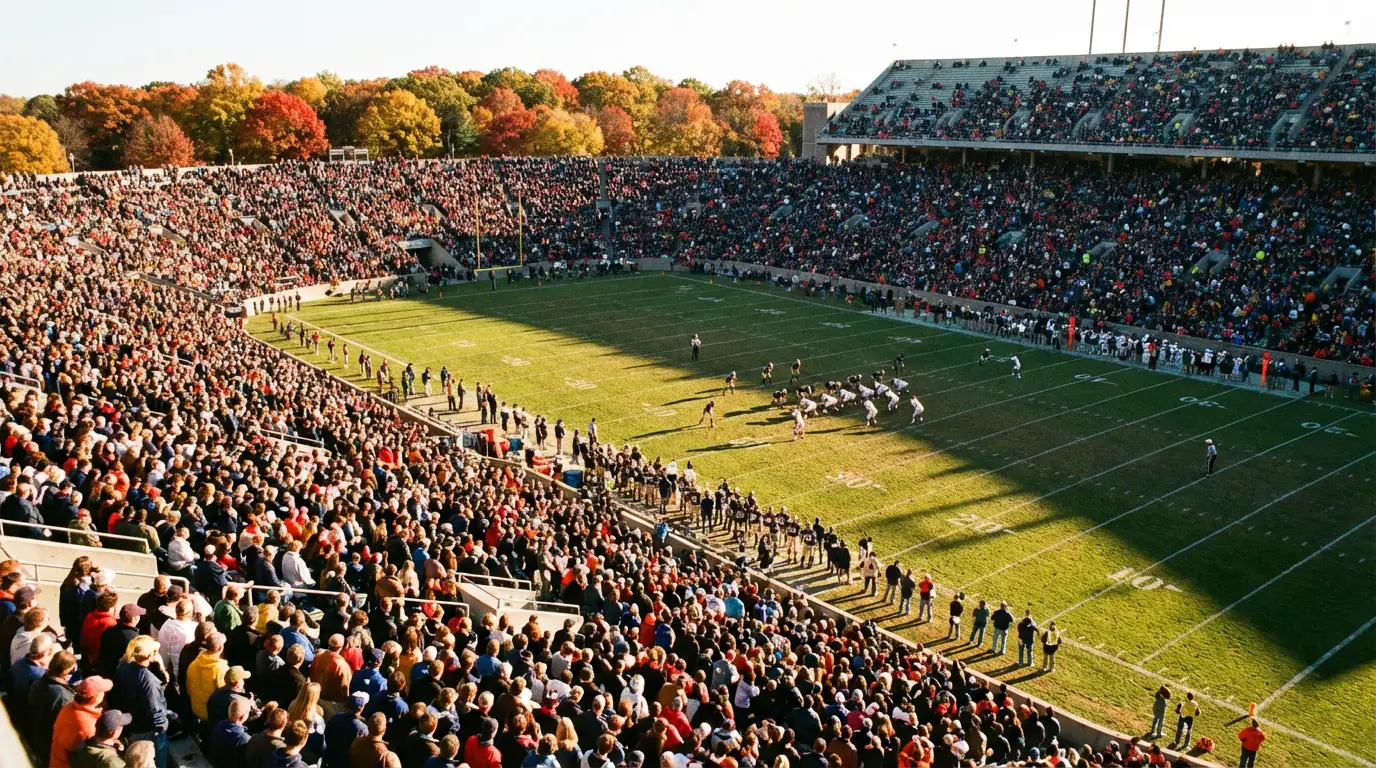
College football betting is the NFL’s wilder, less predictable, and in many ways more exploitable cousin. The NCAA features over 130 FBS teams playing a 12-game regular season, and the talent gaps between them are enormous. A top-5 program might be 40 points better than a bottom-tier team on a neutral field. The NFL has nothing close to that disparity. For bettors, this extreme range of quality creates both massive spreads and unique opportunities that do not exist in professional football.
The college game also differs in structure, pace, and culture. Offenses run more plays per game, scoring is higher, and the clock rules produce faster action. Home-field advantage is substantially larger than in the NFL. Coaching matters more because roster turnover is constant and schematic preparation is often the difference between an upset and a blowout. If you approach college football betting with the same framework you use for the NFL, you will miss critical factors — and leave money on the table.
NCAA Matchups vs NFL Betting Markets
The most significant difference is the talent gap between teams. In the NFL, every team has professional-caliber players at every position. The gap between the best and worst NFL rosters might be 10-14 points on a neutral field. In college football, the gap between Alabama and a mid-tier Group of Five team can exceed 30 points. This means spreads routinely reach -20, -30, or even -40 in mismatches. Betting on massive spreads introduces a different kind of analysis: instead of “will Team A win by more than 3?” you are asking “will Team A’s second-string offense score enough in the fourth quarter to cover a 35-point number?”
Roster turnover is another fundamental difference. NFL rosters are relatively stable year to year, with free agency and the draft producing incremental changes. College rosters turn over by 25-30% every year through graduation, transfers, and early NFL draft entries. The transfer portal, which has transformed college football since 2021, means that a team’s roster in September might look dramatically different from the previous December. Betting on college football in the early season requires projecting roster quality with incomplete information, and the sportsbook’s early-season lines reflect that uncertainty.
The pace of play affects totals significantly. College offenses average more plays per game than NFL offenses because the clock stops on every first down until the ball is set. Some programs run up-tempo spread offenses that can execute 80-90 plays in a game. When two high-tempo teams meet, the number of possessions — and therefore scoring opportunities — dwarfs a typical NFL matchup. College totals regularly sit in the 55-70 range for these matchups, and understanding which teams play fast versus slow is essential for totals analysis.
Conference play creates scheduling patterns that matter for betting. The SEC, Big Ten, Big 12, and ACC each have their own competitive dynamics, travel patterns, and traditional rivalries. Teams that dominate non-conference cupcakes in September may struggle once conference play begins and the opponent quality increases. A team sitting at 4-0 with a gaudy point differential heading into October might be inflated by weak scheduling, and the market sometimes takes too long to adjust when conference play exposes real limitations.
Home-Field Advantage: Why It Matters More in College
Home-field advantage in the NFL has shrunk to roughly 1.5-2 points in recent years. In college football, the number is significantly larger — estimates range from 2.5 to 4 points depending on the venue and the methodology used. Certain stadiums carry an outsized advantage that goes beyond the generic number. Playing at Death Valley in Baton Rouge on a Saturday night, with 100,000 fans creating noise levels that disrupt offensive communication, is not the same as playing at a half-empty mid-major stadium in a noon kickoff.
The reasons for the amplified advantage are structural. College players are younger and more susceptible to the emotional pressure of a hostile crowd. Communication breakdowns caused by crowd noise are more frequent because college offenses often rely on complex pre-snap reads and audibles that require precise verbal communication. Travel effects are more pronounced because college teams have less institutional travel infrastructure than NFL franchises — chartered planes, five-star hotels, and professional support staffs are not universal at the college level.
Certain venues have become notorious for their impact on visiting teams. Stadiums with above-average home-field effects include LSU’s Tiger Stadium, Clemson’s Memorial Stadium, Ohio State’s The Horseshoe, Penn State’s Beaver Stadium, and Texas A&M’s Kyle Field. When a ranked team visits one of these venues, the home advantage baked into the spread may not fully capture the environmental impact, particularly for road teams that play most of their schedule in smaller, quieter stadiums. Tracking venue-specific home records against the spread provides a layer of data that generic models miss.
The flip side is that neutral-site games — increasingly common in early-season showcases and bowl games — eliminate home-field advantage entirely. When two teams meet at a neutral venue, the standard home-field adjustment disappears, and the line should reflect pure team quality. If the market still prices in a phantom home-field edge for the team listed as “home” in a neutral-site game, the other side has value.
Betting the College Football Playoff and Bowl Season
The College Football Playoff expanded to 12 teams starting with the 2024-25 season, fundamentally changing the postseason betting landscape. The larger field means more games, more matchups between teams from different conferences, and more opportunities for the market to misprice teams whose strength has been assessed primarily against conference opponents. A team that dominated the Big 12 might be overvalued against a physical SEC opponent because the stylistic differences between conferences are significant and difficult for generic models to capture.
Bowl season — the weeks of games between conference championship weekend and the national championship — generates enormous public betting volume. Motivation is the critical variable. Some teams are thrilled to play in a prestigious bowl, while others are deflated after missing the playoff. Star players increasingly opt out of non-playoff bowls to protect their NFL draft stock, and those absences can shift a team’s true quality by several points. The line may adjust for publicly announced opt-outs, but late decisions — sometimes coming the day before the game — create brief windows where the market has not fully priced the missing player.
Rivalry week, typically the final week of the regular season, produces some of the most watched and most bet college football games of the year. The historical narrative of rivalries is powerful, and public money flows toward tradition and recent trends. A team that has won four straight against its rival attracts heavy action regardless of the current season’s form. Smart bettors evaluate each rivalry game on its current-season merits — offensive efficiency, defensive matchups, injury status — rather than defaulting to historical patterns. Rivalry games produce higher variance than regular conference games because emotional intensity inflates or deflates performance in ways that data cannot fully measure, which means the under-priced side is frequently the one the public is ignoring.
Strategies Specific to College Football
Several betting strategies work in college football that have limited or no applicability in the NFL. The most important is exploiting the lack of market efficiency in games involving smaller programs. The sportsbook dedicates its sharpest models and most attention to marquee matchups — top-25 teams, nationally televised games, rivalry weekends. Games between two unranked Group of Five teams on a Tuesday night receive a fraction of that analytical effort. The lines are still set, but they are set with less confidence and attract less sharp money, which means inefficiencies persist longer.
Specializing in a single conference or a subset of teams is a powerful approach. A bettor who follows every game in the Sun Belt Conference has a deeper understanding of each team’s actual quality than any national model can provide. They know which teams lost their best defensive player to injury three weeks ago. They know which freshman quarterback is developing rapidly. They know which coaching staff makes excellent halftime adjustments. This granular knowledge, applied to games that the broader market barely analyzes, creates an edge that scales with the bettor’s depth of expertise.
First-half betting is particularly effective in college football because of the blowout factor. When a 30-point favorite leads 35-0 at halftime, the second half becomes garbage time — backups enter, the pace slows, and the favored team’s scoring rate collapses. Full-game spreads of -35 or -40 often hinge on whether the favored team continues scoring in the fourth quarter, which is largely a function of coaching philosophy rather than team quality. First-half spreads isolate the competitive portion of the game and remove the variance of garbage-time performance. If your analysis says a team is significantly better, the first-half line lets you bet on that superiority without worrying about late-game randomness.
The under in games with massive spreads is another college-specific angle. When a team is favored by 30 or more, the trailing team’s offense often stalls completely against the first-string defense. The favored team builds a huge lead, then pulls starters, and the second-half scoring rate drops off a cliff. Totals in these mismatches tend to overestimate scoring because the posted number assumes a relatively normal game flow, while the actual game flow — a dominant first half followed by a low-scoring second half — produces fewer total points than the line suggests.
The 130-Team Puzzle
College football is overwhelming by design. No bettor can meaningfully analyze 65 games on a Saturday, and the sportsbook counts on that impossibility. The sheer volume of games each week guarantees that some lines receive minimal scrutiny — and those are the lines where edges are most likely to survive until kickoff.
The winning approach is not to try to bet everything. It is to bet less and know more. Pick your lanes — a conference, a tier of matchups, a specific bet type — and develop genuine expertise. The bettor who knows every roster detail in the MAC has a larger edge in those games than a generalist has in a top-25 showdown where dozens of sharp models are fighting over half-points. College football rewards specialists the same way the stock market rewards sector analysts: depth of knowledge in a niche consistently outperforms surface-level knowledge across the entire landscape.
That is the paradox and the promise of NCAA betting. The market is less efficient than the NFL, which means more opportunities exist. But those opportunities are scattered across 800-plus games per season, hidden in time slots and matchups that most bettors never look at. Finding them requires not a better algorithm, but a narrower focus and a willingness to watch games that nobody else is watching.
