
Hedging is the act of placing a second bet on the opposite side of your original wager to guarantee a profit — or at least minimize a loss — regardless of the outcome. It is one of the most discussed and least understood strategies in football betting. Some bettors see hedging as smart money management. Others call it a sign of weak conviction. The truth sits somewhere in between, and the math, as usual, has the final word.
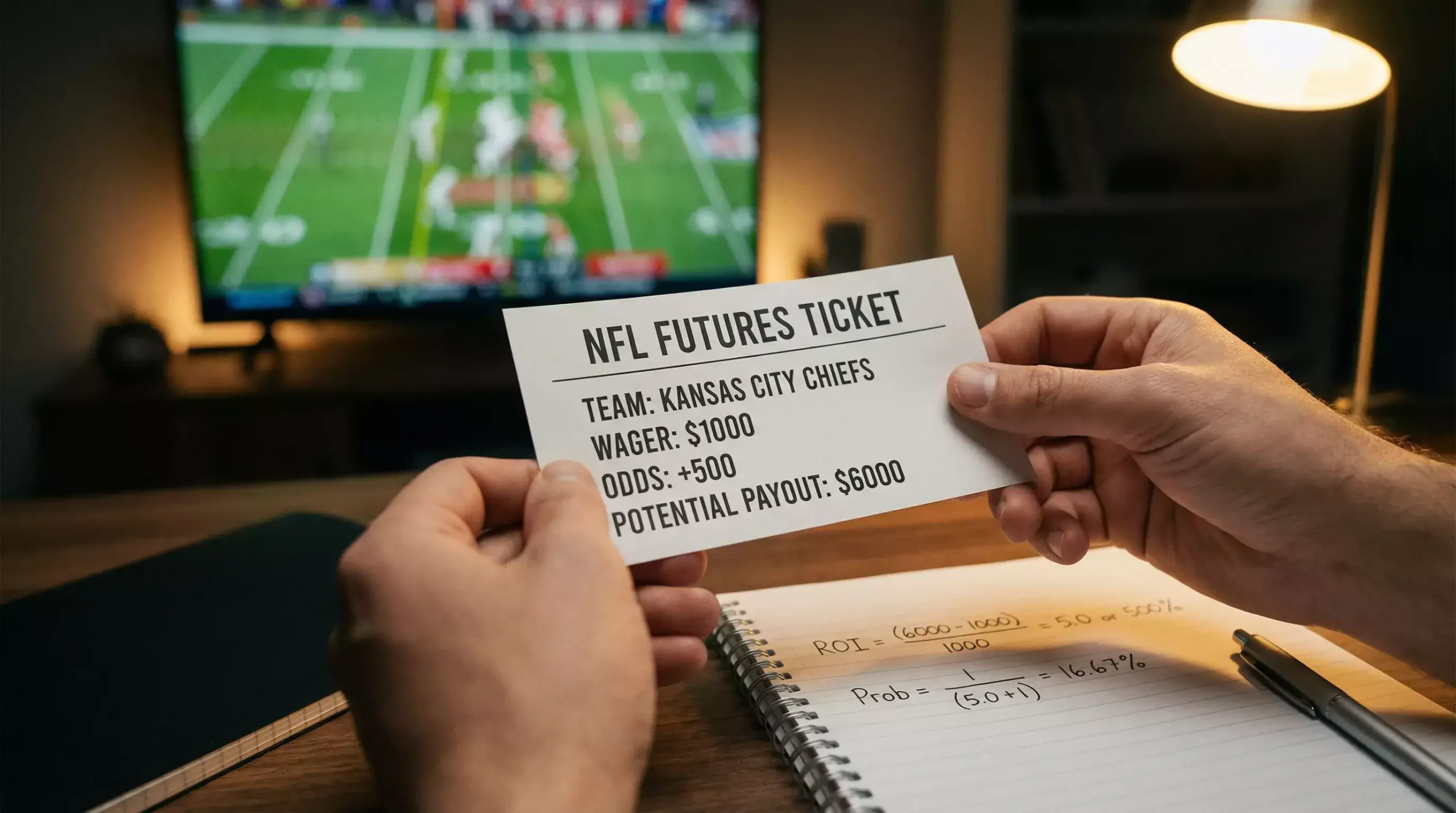
The appeal of hedging is obvious: you can lock in guaranteed money when your original bet has gained value. If you bet on a team to win the Super Bowl at +2000 and they reach the championship game, you are sitting on a potential $2000 profit. Hedging lets you convert some of that potential into certainty. The cost is a reduced maximum payout, and the skill is knowing when that trade-off makes financial sense versus when it destroys the expected value you worked to build.
Calculating Optimal Hedging Scenarios
Not every profitable position deserves a hedge. The decision to hedge should be driven by specific circumstances, not by anxiety about a bet that is going well. Hedging always costs expected value — you are paying for certainty by giving up upside — so the justification needs to be concrete.
The strongest case for hedging is when the potential payout is life-changing or financially significant relative to your bankroll. If your $50 futures bet on a long shot is now worth $5000 and you can hedge to guarantee $2500 regardless of the outcome, the guaranteed money might mean more to you than the additional $2500 you could win by letting it ride. This is a utility argument, not a math argument. The expected value of not hedging might be higher, but the real-world value of locking in $2500 — money that could pay a bill, fund an investment, or cover months of betting bankroll — might outweigh the mathematical optimum.
The second valid reason to hedge is when the circumstances of the original bet have changed in a way that undermines your initial thesis. Suppose you bet the Chiefs to win the Super Bowl because of Patrick Mahomes, and Mahomes suffers a significant injury in the conference championship game. The Chiefs might still win, but the probability has dropped substantially. Hedging against the original position — by betting on the other team in the Super Bowl — reflects an updated assessment of the situation rather than a failure of conviction.
The weakest reason to hedge is pure nervousness. If your analysis was sound when you placed the bet and nothing material has changed, hedging just because the game is getting close means you are paying a premium to relieve anxiety. That premium adds up over time. Bettors who hedge every position out of fear end up with a portfolio of guaranteed small profits that underperform the returns they would have earned by letting their winning positions play out.
Hedging Futures: The Most Common Application
Futures bets are the natural home of hedging because they play out over weeks or months, giving the bettor multiple opportunities to hedge at different stages. A Super Bowl futures bet offers at least three potential hedge points: the divisional round, the conference championship, and the Super Bowl itself.
Consider a practical example. You bet $100 on the Baltimore Ravens at +1800 to win the Super Bowl. The Ravens make it through the wild card and divisional rounds and are now playing in the AFC Championship game. Your ticket is worth up to $1900 if the Ravens win the Super Bowl, but they still need to win two more games.
At the conference championship, the opponent’s moneyline is -130. You can bet $500 on the opponent. If the opponent wins, you collect $385 profit from the hedge but lose your $100 futures bet, netting $285. If the Ravens win, you lose the $500 hedge but still hold a live ticket worth $1900 heading into the Super Bowl. Your net position entering the Super Bowl would be the $1900 potential minus the $500 already lost on the hedge, for an effective $1400 upside.
Alternatively, you can wait until the Super Bowl itself to hedge. If the Ravens are underdogs at +150 in the Super Bowl, the opposing team’s moneyline might be -170. A $1000 hedge on the opponent at -170 returns roughly $588 if the opponent wins. Subtracting your original $100 and the $1000 hedge cost, you net a loss of $512. Wait — that does not sound right. Let me walk through it cleanly.
If the opponent wins: you collect $588 from the hedge, lose the $100 futures bet, and spend $1000 on the hedge. Net: $588 – $100 – $1000 = -$512. That is a loss, not a hedge. This illustrates why the math matters — you need to size the hedge correctly to guarantee a positive outcome on both sides, which requires careful calculation rather than an arbitrary bet amount.
The Correct Hedge Calculation
The proper way to size a hedge is to work backwards from your desired guaranteed profit. Start with the potential payout of your original bet if it wins, then calculate how much you need to bet on the opposite side so that both outcomes produce the same net profit (full hedge) or so that both outcomes produce an acceptable positive return (partial hedge).
The formula for a full hedge on a moneyline bet is: Hedge Amount = (Original Potential Payout) / (Hedge Odds Payout Ratio + 1). Using the Ravens example: your original bet pays $1900 total ($1800 profit + $100 stake) if they win the Super Bowl. The opponent is at -170 on the moneyline, which pays 1.588 to 1 in total return. Hedge Amount = $1900 / (1.588) = $1196. If you bet $1196 on the opponent at -170, a win returns $1196 x 1.588 = $1899 — essentially matching your futures payout. If the opponent wins, you pocket roughly $1899 minus $100 original futures loss minus $1196 hedge = $603 profit. If the Ravens win, you pocket $1900 minus $1196 hedge lost minus $100 original futures cost = $604 profit. Both sides are positive, and both produce approximately equal returns — which is exactly what a full hedge is designed to do.
A partial hedge uses a smaller amount, leaving more upside if your original pick wins while accepting less profit if the hedge side wins. If you only wager $600 on the opponent at -170, a win returns $953. Net if opponent wins: $953 – $100 – $600 = $253 profit. Net if Ravens win: $1900 – $600 = $1300 profit. The partial hedge protects you from a total loss while preserving significant upside. The ratio you choose depends on how much you need the guaranteed money versus how much you want to let the original position breathe.
Hedging Parlays: The Final Leg Decision
Parlay hedging is the scenario most bettors actually encounter. You have a four-team parlay, three legs have won, and the fourth is about to kick off. The payout if the final leg hits is $500 on a $50 bet. Do you hedge by betting the other side of the final game?
The math follows the same structure as futures hedging. Your parlay pays $500 total if the final leg wins. The other side of that game is available at some moneyline. Say the opponent is +120. A $200 bet on the opponent returns $440 if they win. If the opponent wins: you collect $440 from the hedge, lose the $50 parlay (already spent), and spent $200 on the hedge. Net: $440 – $200 = $240 profit (the $50 parlay cost is sunk). If your parlay leg wins: you collect $500 from the parlay and lose $200 on the hedge. Net: $500 – $200 = $300 profit. Either way, you profit — $240 or $300 — instead of the all-or-nothing outcome of $500 or $0.
Whether this makes sense depends on the same utility calculation as futures hedging. If $300 guaranteed is worth more to you than a 55% chance of $500 combined with a 45% chance of $0, hedge. If your bankroll is large enough that the $50 parlay cost is insignificant and you believe the final leg is a strong pick, letting it ride preserves more expected value.
The key discipline is running the numbers before the game starts. Once the final leg kicks off, emotions take over. If the game opens with two quick touchdowns favoring your side, you will feel brilliant for not hedging. If the other team takes an early lead, you will wish you had. Making the hedging decision before any game action removes the emotional distortion and ensures the choice is based on math rather than momentum.
Hedging Too Often: The Hidden Cost
Habitual hedging is one of the most expensive habits a bettor can develop. Every hedge costs expected value. The sportsbook charges vig on the hedge bet, and the vig on two opposing bets (your original and the hedge) is guaranteed loss for you and guaranteed profit for the book. Over a season of regular hedging, the cumulative vig cost can consume a significant portion of your returns.
Think of it this way. If you place 20 futures or parlay bets per year and hedge half of them, you are placing 10 additional bets that each carry vig. At standard -110 juice, each hedge costs you roughly 4.5% in margin. Ten hedges at $200 average size means $2000 in additional handle with roughly $91 in vig lost. That is $91 in pure friction cost for the privilege of converting uncertain profits into certain ones. Over five years, the cumulative cost exceeds $450 — money that went to the sportsbook rather than your pocket.
The Math of Letting Go
Hedging ultimately forces a question that most betting advice avoids: how much is certainty worth to you? The answer is personal. A professional bettor with a large bankroll and a long time horizon should almost never hedge because the expected value sacrifice compounds over thousands of bets. A recreational bettor with a once-in-a-lifetime futures ticket reaching the Super Bowl might find that locking in $1000 guaranteed means more than chasing an additional $800 in potential profit.
The honest framework is this. If the guaranteed amount from hedging would meaningfully change your financial situation — pay off a debt, fund something important, replenish a depleted bankroll — hedge without guilt. If the guaranteed amount is just “nice to have” and you are hedging to avoid the sting of a possible loss, you are paying the sportsbook to manage your emotions. That is a service the book is happy to provide, but it is not free, and recognizing the cost is the first step toward making the choice deliberately rather than reflexively.
