
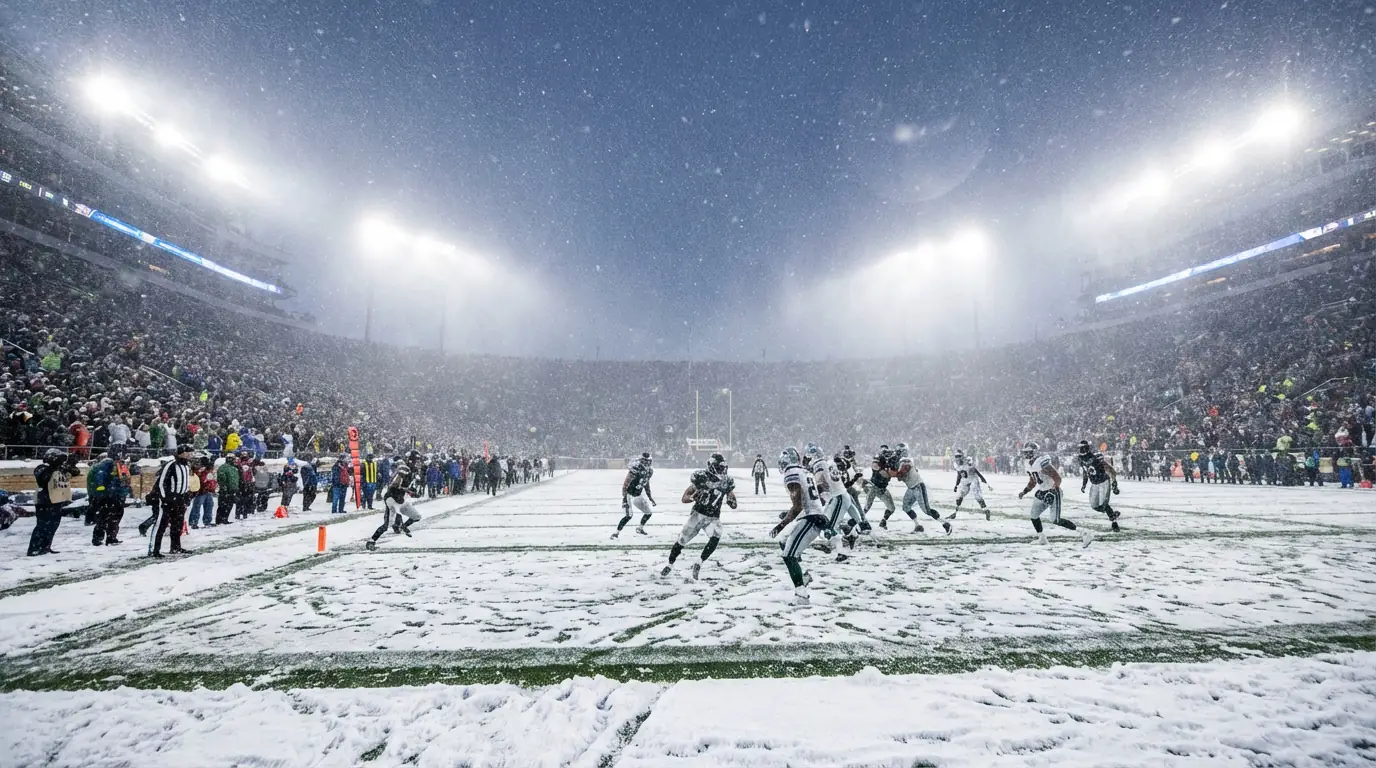
Football is one of the few major professional sports still played outdoors in uncontrolled conditions. Twenty-one of the NFL’s 32 teams play in open-air stadiums, and college football is almost entirely an outdoor affair. That means weather is not a background detail — it is an active variable that affects scoring, strategy, and ultimately the outcome of bets. And yet most bettors treat a rainstorm the same way they treat a sunny day: they ignore it.
Weather creates predictable shifts in how football games are played. Wind suppresses the passing game. Rain increases turnovers. Snow compresses scoring. Extreme cold changes kicking accuracy. Each of these effects can push the actual game total or margin away from the number the sportsbook posted, especially when the line was set days before the forecast became clear. Bettors who incorporate weather data into their analysis gain an edge that is both measurable and consistently underpriced by the market.
Severe Wind Constraints on NFL Passing Props
Wind is the most impactful weather variable in football betting, and it is also the one that the market consistently underadjusts for. The reason is aerodynamic: a football is an oblong, irregularly shaped object that becomes dramatically harder to throw accurately when wind speeds exceed 15 miles per hour. Deep passes lose trajectory. Spiral tightness deteriorates. Punts and kickoffs become unpredictable. Field goal accuracy drops measurably.
Research on NFL games played in winds above 20 mph shows an average reduction in total scoring of roughly 5-9 points compared to calm conditions. That is an enormous effect — it can shift a total from over to under by itself. At 15 mph, the impact is smaller but still statistically significant, particularly on deep passing plays over 20 yards. Quarterbacks who rely on deep ball accuracy — the sort of passers who thrive in controlled environments — see their production decline disproportionately. Quarterbacks with compact, quick-release throwing mechanics and teams that lean on the running game are less affected.
The practical application for totals betting is straightforward: check the wind forecast for every outdoor game. If sustained winds are projected above 15 mph at kickoff, evaluate whether the posted total has adjusted adequately. In many cases, the line moves 1-2 points for wind, but the actual scoring impact is larger. That gap between the adjustment and the reality is where the under finds consistent value in windy conditions.
Wind also affects spread betting, though less directly. A team whose offensive identity is built around a vertical passing attack faces a larger disadvantage in wind than a team that runs power formations and relies on short, timing-based throws. If the spread does not account for this asymmetric impact, the run-heavy team has value. Divisional games in outdoor stadiums — where one team is accustomed to wind conditions and the other is not — add another layer. A team that plays eight home games in the Midwest wind has a built-in adjustment that a dome team visiting in December does not.
Rain and Snow: The Grip Problem
Rain affects football primarily through ball security. A wet football is harder to grip, harder to throw with precision, and harder to hold onto through contact. Fumble rates increase in rain, and incomplete pass rates rise as well. The combined effect reduces offensive efficiency on both sides, which suppresses scoring.
The impact of rain on totals is moderate compared to wind — typically 2-4 points depending on severity. Light rain barely registers. Steady rain throughout the game has a more consistent effect. A downpour that begins at halftime can shift second-half scoring dramatically while the first half played out normally. The timing of rainfall matters as much as its presence, which means checking an hourly forecast is more useful than a generic “rain expected” prediction.
Snow creates a visual spectacle and a betting opportunity. Light snow — flurries or a light dusting — has minimal impact on gameplay. The ball stays relatively dry, footing is manageable, and scoring continues at near-normal rates. Heavy snow is a different story. Accumulation on the field makes cutting and route-running treacherous, reduces visibility for both quarterbacks and receivers, and turns the game into a ground-based slugfest. Under these conditions, the game total can come in well below the posted number, particularly if neither team has a dominant rushing attack to compensate for the lost passing efficiency.
The market often overreacts to the visual drama of snow while underreacting to the actual mechanical impact. A game with two inches of snow on the ground but calm winds might play closer to normal than the odds suggest, because the footing issue affects both teams equally and the passing game can still function at short and intermediate depths. Meanwhile, a game with no snow but 25 mph gusts is mechanically more disruptive but receives less public attention because wind is invisible. This perception gap creates recurring value for bettors who focus on the actual forecast details rather than the weather headline.
Temperature: The Subtle Factor
Extreme cold does not carry the same dramatic effect as wind or heavy precipitation, but it introduces meaningful changes to several aspects of football that influence betting outcomes. The most direct impact is on kicking. Field goal accuracy drops in sub-freezing temperatures because the football becomes harder and less responsive to the kicker’s foot, reducing both distance and precision. Studies on NFL kicking data show a measurable decline in field goal percentage when temperatures drop below 20 degrees Fahrenheit, particularly on attempts over 40 yards.
This kicking effect has a specific implication for totals. If field goals become less reliable, the floor for scoring drops. A team that would normally cash in three red zone stalls with field goals might miss one or two of those attempts in extreme cold, subtracting 3-6 points from the game total. The total posted by the sportsbook may or may not reflect this reduction, especially for indoor-conference teams traveling to cold-weather venues where their kicker has limited experience in freezing conditions.
Cold also affects quarterback grip, though modern hand warmers and heated benches have reduced this issue compared to earlier decades. The bigger impact in extreme cold is on play calling philosophy. Coaches tend to lean on the running game in brutally cold weather, partly out of genuine tactical concern about passing accuracy and partly out of a conservative instinct that cold weather reinforces. A heavier run-game focus reduces the number of explosive plays, shortens drives in terms of clock time, and compresses scoring output. Two teams grinding the ball on the ground produce fewer total plays and fewer points than two teams throwing efficiently in a climate-controlled dome.
Heat is the forgotten variable. Early-season games in September, particularly in southern venues like Miami, Tampa, or Arizona, feature temperatures that can exceed 90 degrees with significant humidity. Fatigue becomes a factor in the second half, particularly for visiting teams not acclimatized to the conditions. Defensive linemen rotate more frequently, conditioning gaps between rosters become visible, and the pace of play can slow in the fourth quarter. The effect on totals is mixed — sometimes the fatigued defense gives up more late points, sometimes the fatigued offense cannot sustain drives. The edge here is less about the total and more about the spread, where the home team’s acclimation advantage provides a small but real advantage that visiting teams from northern cities do not share.
Adjusting Totals for Weather: A Practical Framework
The challenge with weather betting is not knowing that weather matters — most bettors understand that at a basic level. The challenge is quantifying the impact precisely enough to identify when the sportsbook’s adjustment falls short of the actual effect.
A rough framework for weather adjustments on NFL totals works as follows. For wind above 15 mph sustained, subtract 3-4 points from your projected total. For wind above 20 mph, subtract 5-8 points. For steady rain throughout the game, subtract 2-3 points. For heavy snow with accumulation, subtract 4-6 points. For temperatures below 20 degrees, subtract 1-2 points on top of any wind or precipitation adjustment. These numbers are approximations derived from historical scoring data, and they vary based on the specific teams involved — a run-heavy team in wind is less affected than a pass-heavy team.
Cross-reference your adjusted total against the posted number. If your weather-adjusted projection is 38 and the sportsbook has the total at 42.5, the under carries value. If the book already moved the total to 37.5 and your projection is 38, the value has been absorbed and the bet is closer to a coin flip. The key is comparing your number to the market’s number, not just assuming that bad weather automatically means the under hits.
Weather data is freely available. The National Weather Service provides hourly forecasts for every city with an NFL stadium. For games later in the week, check the forecast on Friday and again Saturday morning for updated conditions. Pay attention to sustained wind speed rather than gusts — gusts are intermittent and less predictive of consistent impact than steady winds. Also note the wind direction relative to the field orientation, though this matters more for kicking accuracy than for overall scoring.
The Forecast No One Reads
Weather is the most underused publicly available information in football betting. Injury reports get dissected by millions. Power ratings are debated on every podcast. But the hourly wind speed forecast for an outdoor stadium in December gets checked by a fraction of bettors despite having a documented, measurable impact on scoring that exceeds most injury adjustments.
The reason is psychological. Weather feels like a secondary factor — something that affects the ambiance of the game rather than the outcome. But the data tells a different story. A 25-mph wind at Soldier Field suppresses passing yards more reliably than the absence of a team’s third wide receiver. Heavy rain at MetLife Stadium increases turnover probability more than a backup left guard does. These are verifiable, quantifiable effects that the market consistently prices imperfectly because most bettors do not bother to look.
The edge from weather analysis is not dramatic on any single game. It is a 2-3% improvement in your totals accuracy across the games where weather is a genuine factor, which might be 20-30 games per NFL season. But 2-3% over 25 bets at proper stakes adds up to meaningful profit, and the information required to capture it is free, updated daily, and ignored by your competition.
